Reviewed by Dr. Ali Tameemi, DDS
A painless cavity can still be actively destroying your tooth — and waiting for discomfort to appear is one of the most expensive mistakes patients make. The biology of tooth decay means pain is a late symptom, not an early warning. Here's what actually determines whether you need a cavity filling.
The Biological Point of No Return: Why "Watching" a Cavity Has a Deadline
When a patient is told a dentist wants to "watch" a small cavity, the reasoning can seem confusing. For Spring-area patients, the explanation is that what is actually being tracked is whether the decay has crossed a specific threshold — the enamel-dentin junction, or EDJ.
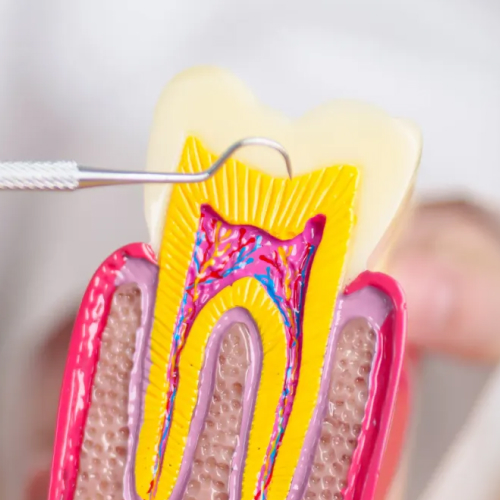
Here's the biology. Your tooth's outer enamel is dense, mineral-rich, and relatively resistant to acid. If decay stays confined to the enamel, your body can sometimes reverse it. Fluoride treatments, improved brushing, and dietary changes can remineralize weakened enamel before a true cavity forms. That's the "watch" window.
The EDJ is where enamel ends and dentin begins. Dentin is softer, more porous, and far more organic in composition. Once bacterial acid crosses that junction, the decay spreads rapidly — not slowly — because dentin offers much less resistance. According to Mayo Clinic, once decay reaches the dentin layer, it progresses faster and sensitivity increases significantly.
At that point, remineralization is no longer possible. A filling becomes necessary regardless of whether any discomfort is felt.
The questions worth asking your dentist: Has the decay reached the dentin? Is it past the EDJ? Those answers determine whether you're in the "watch" zone or the "fill now" zone — not whether your tooth hurts.
The Hidden Cavity Problem: Why No-Pain Cavities Between Teeth Are Urgent
Most patients imagine a cavity as a visible pit on a chewing surface. But the cavities found most often in clinical practice — and the ones patients most frequently delay treating — are interproximal cavities. These form between teeth, where a toothbrush never reaches.
The enamel on the sides of your teeth is thinner than on the chewing surface. That means the window between "small, easy filling" and "this now needs a root canal" is dramatically shorter. These cavities are invisible without X-rays, rarely cause pain until they've reached the pulp, and grow silently for months or years.
Healthline explains that cavities between teeth often produce no symptoms until decay reaches the dentin or pulp — by which point a simple filling may no longer be sufficient.
This is exactly why bitewing X-rays are taken at regular intervals even when a mouth feels completely fine. A "no pain" cavity between the back molars can be quietly consuming tooth structure with zero sensation. By the time it hurts, the situation often calls for a root canal and tooth crown rather than a straightforward filling.
If it's been more than a year since your last X-rays, there's a reasonable chance something is developing between your teeth that cannot be detected without imaging.
The 50% Rule: Why Waiting for Pain Turns a Hundred Dollar Problem Into a Thousand Dollar One
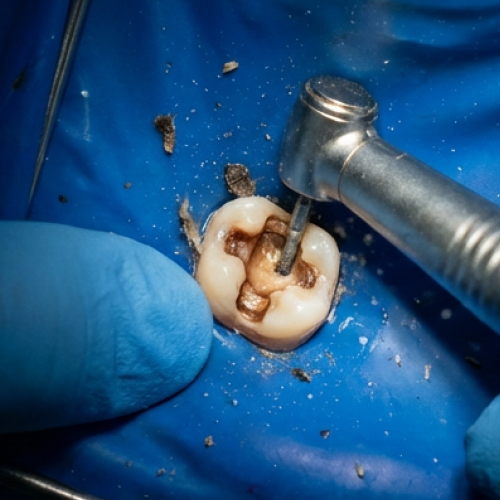
This is the structural reality of tooth decay that most patients don't consider. A dental filling isn't just a plug — it relies on the surrounding tooth walls for support. When those walls are intact and healthy, a filling bonds well and lasts for years. Cleveland Clinic notes that well-placed fillings in teeth with sufficient remaining structure can last up to 20 years.
The problem is that decay doesn't stop growing while treatment is delayed. It consumes the internal structure of your tooth — the walls, the cusps, the foundation. Once decay has eaten through roughly 50% or more of a tooth's width, there often isn't enough healthy structure remaining to support a filling reliably. The tooth is likely to crack under chewing pressure, or the filling will fail.
At that point, a crown becomes necessary. Sometimes a root canal first, then a crown. The cost difference is significant, and the procedure is far more involved.
The cavity that costs the least to fix — in time, money, and tooth structure — is always the one treated earliest. Pain is a sign that decay has already reached the nerve-containing pulp. Research published in PMC confirms that cavity size is directly related to restoration longevity: larger cavities mean shorter-lasting restorations and higher failure rates.
So when a filling is recommended on a tooth that feels completely normal, that recommendation is not a sign of excessive caution — it reflects an effort to catch the problem before the structural math stops working in the patient's favor.
So How Do You Actually Know If You Need a Filling?
The honest answer: patients usually cannot know on their own. Pain, sensitivity to sweets, and visible holes are all signs that decay has already progressed significantly. The NIDCR confirms that early tooth decay rarely causes symptoms — which is precisely why professional diagnosis with X-rays matters.
What dentists look for during a cleaning and exam includes:
- Radiographic evidence of decay between teeth or beneath existing restorations
- Tactile softness when probing — a healthy tooth surface is hard; decay feels soft or sticky
- Depth relative to the EDJ — whether we're watching or acting
- Cavity location — an interproximal cavity gets treated more urgently than a surface spot of similar size
If your dentist recommends a filling on a tooth that doesn't hurt, that recommendation is based on clinical findings, not guesswork. The absence of pain means it was caught early — which is genuinely good news.
Schedule Your Exam at Nu Dentistry Spring
If you're in the Spring, Texas area and wondering whether a small cavity needs attention — or if it's been a while since your last X-rays — don't wait for discomfort to make that call. At Nu Dentistry Spring, digital X-rays and thorough clinical exams are used to catch decay at the stage where treatment is simplest. If a dental emergency arises before your scheduled visit, don't hesitate to reach out right away. Reach out to schedule your visit today.
This article is intended for general informational purposes only and does not constitute professional dental or medical advice. For diagnosis and treatment recommendations specific to your situation, please consult a licensed dental professional.