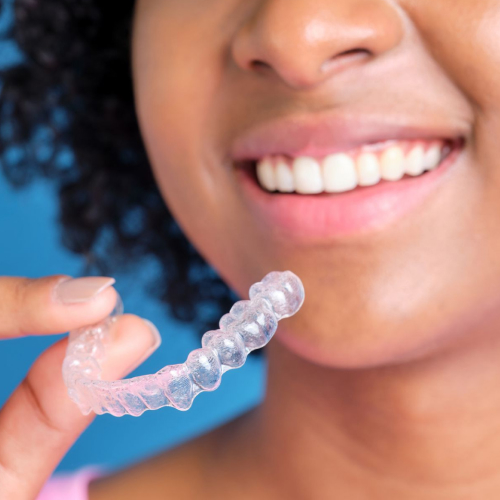
Invisalign Trays Not Fitting? A Spring, TX Dentist Explains Gaps, Tracking, and Refinements
Invisalign trays not fitting right in Spring, TX? Learn about tracking, gaps, and refinements. Call Nu Dentistry Spring today.
Read More
Choosing Invisalign is often about more than straightening teeth. It is about how treatment fits into your life, how predictable the process feels, and whether the results reflect the effort you put in. Many patients start Invisalign thinking it is simply clear aligners instead of metal braces. In reality, the experience is shaped by a mix of daily habits, biology, planning, and support from your dental team.
At Nu Dentistry Spring, we see firsthand that two people can start Invisalign around the same time and have very different journeys. One might glide through treatment smoothly, while another faces delays or frustrations. The difference usually has little to do with the aligners themselves and everything to do with how Invisalign is lived with day to day.
This article looks beyond surface level comparisons and digs into what actually shapes your Invisalign results and overall experience.
One of the biggest reasons people choose Invisalign is how naturally it blends into everyday routines. Unlike traditional braces, Invisalign is designed to adapt to your life rather than force you to adapt around it.
Eating and drinking feel more flexible:
With braces, food choices are limited. Hard, sticky, or chewy foods can damage brackets and wires. Invisalign aligners are removable, which means you can eat what you normally enjoy once the aligners are out. This flexibility makes social meals, holidays, and travel far easier to manage.
That said, Invisalign does introduce responsibility. Aligners must be removed before eating and put back in afterward. Skipping this step or leaving them out too long can affect progress.
Oral hygiene is simpler and more thorough:
Brushing and flossing around braces can feel like a project. With Invisalign, you remove the aligners and clean your teeth as usual. This makes it easier to maintain healthy gums and avoid plaque buildup during treatment.
However, Invisalign requires consistency. Teeth should be brushed before putting aligners back in, especially after meals. Skipping this step can trap food particles and sugars against the teeth.
Speech and comfort tend to improve faster:
Traditional braces can irritate the inside of the mouth for weeks. Invisalign aligners are smooth and custom made, so most patients adjust within a few days. Mild pressure is normal, especially with new aligners, but ongoing discomfort is usually minimal.
Speech changes are also temporary. Some patients notice a slight lisp during the first week or two, but this typically resolves quickly as the tongue adapts.
Appearance affects confidence differently:
While braces are more common and accepted than ever, some adults and teens still feel self conscious wearing them. Invisalign aligners are clear and subtle, which often helps patients feel more confident at work, school, or social events.
Confidence plays a role in compliance. Patients who feel comfortable wearing their aligners are more likely to keep them in for the recommended hours.
Invisalign is highly effective, but it is not one size fits all. Several factors influence how well it works and how smoothly treatment progresses.
1. The starting position of your teeth:
Crowding, spacing, rotations, and bite alignment all affect treatment complexity. Mild to moderate cases often move quickly and predictably. More complex cases may require refinements or longer timelines.
Invisalign technology has advanced significantly, and many cases that once required braces can now be treated with aligners. The key is accurate planning and realistic expectations.
2. Bone biology and tooth movement:
Teeth move through bone, and everyone’s biology is slightly different. Factors like bone density, age, and overall oral health influence how teeth respond to pressure.
Younger patients often experience faster movement, but adults can achieve excellent results as well. The difference is usually pace, not outcome.
3. Consistency with wear time:
Invisalign is typically worn 20 to 22 hours per day. This is not a suggestion. It is the foundation of successful treatment.
Patients who wear aligners inconsistently may experience:
Consistency matters more than perfection. Wearing aligners daily and as instructed leads to smoother, more predictable results.
4. Quality of treatment planning:
Invisalign success begins long before the first aligner is worn. Digital scans, bite analysis, and treatment planning determine how accurately teeth will move.
At Nu Dentistry Spring, careful planning helps reduce surprises during treatment. When the plan matches your biology and goals, Invisalign works far more efficiently.
5. Follow up and monitoring:
Even with advanced technology, Invisalign is not a set it and forget it treatment. Regular check ins allow your dentist to ensure teeth are moving as expected and make adjustments if needed.
Patients who attend scheduled appointments tend to finish treatment closer to their estimated timeline.
Daily habits have a powerful impact on Invisalign results. Small choices made consistently can either support or sabotage progress.
Habits that improve results:
Habits that slow things down:
Invisalign is not just a physical process. It is also emotional. Patients often experience shifts in motivation, confidence, and patience throughout treatment.
Early on, excitement is high. Progress feels fast, and aligners are new. Midway through treatment, motivation can dip. Changes become subtler, and wearing aligners feels routine. Toward the end, anticipation returns as the final result comes into view.
Understanding this emotional rhythm helps patients stay committed even when progress feels slow. Invisalign works gradually by design, and steady change is usually the most stable change.
One common misconception is that Invisalign guarantees results on its own. In truth, Invisalign is a tool. The outcome depends on how that tool is used and supported.
Your dentist provides planning, monitoring, and guidance. You provide daily commitment and communication. When both sides do their part, Invisalign delivers predictable and satisfying results.
At Nu Dentistry Spring, we focus on helping patients understand not just what to do, but why it matters. This shared understanding leads to better experiences and better smiles.
Whether you are considering Invisalign or currently in treatment, the best next step is a personalized conversation. Every smile has its own story, and every Invisalign plan should reflect that.
If you are ready to explore Invisalign or want to make sure your treatment is on the right track, schedule an appointment with Nu Dentistry Spring. Our team is here to guide you through each phase with clarity, care, and realistic expectations.
Fresh news from the dental world


See what a visit to our modern, state-of-the-art dentist office is like!





Sunday Closed
Monday - Friday 9am - 6pm
Saturday 9am - 3pm
Check out what our patients are saying in Spring, TX


“The Best Dentist In Spring”
We have been looking for a family dentist for a long time, we have tried a bunch of places but nothing felt quite like home. Not too long ago we stumbled upon Nu Dentistry and met Dr. Ali. Not only was he professional, kind, and gentle, but he always finds a way to fit us in when we need an appointment. He’s also pretty funny! I appreciate that he takes the time to explain what he’s doing, before he does it. That really puts me at ease.

“Never Thought I'd Say It”
I never thought I’d say it, but going to the dentist is actually fun now. I recently came in for a root canal, and I got to sit back and catch up on Stranger Things without any pain!

“Anxiety Has Kept Me Away ”
I usually have such huge anxiety when I go to a dentist appointment, which means I always put off visits until the last minute to disastrous consequences. However, Dr. Loggins helped me with sedation, so the entire process was a breeze!
“The Best Dentist In Spring”
We have been looking for a family dentist for a long time, we have tried a bunch of places but nothing felt quite like home. Not too long ago we stumbled upon Nu Dentistry and met Dr. Ali. Not only was he professional, kind, and gentle, but he always finds a way to fit us in when we need an appointment. He’s also pretty funny! I appreciate that he takes the time to explain what he’s doing, before he does it. That really puts me at ease.
“Never Thought I'd Say It”
I never thought I’d say it, but going to the dentist is actually fun now. I recently came in for a root canal, and I got to sit back and catch up on Stranger Things without any pain!
We are proud members of these dental organizations and accreditations


We are dedicated to providing you with only the best quality dental care


